Tuesday, July 11, 2006

SUBFUSC - LET IT ENDURE FOR EVER

OPINION PIECE
LET IT ENDURE FOR EVER

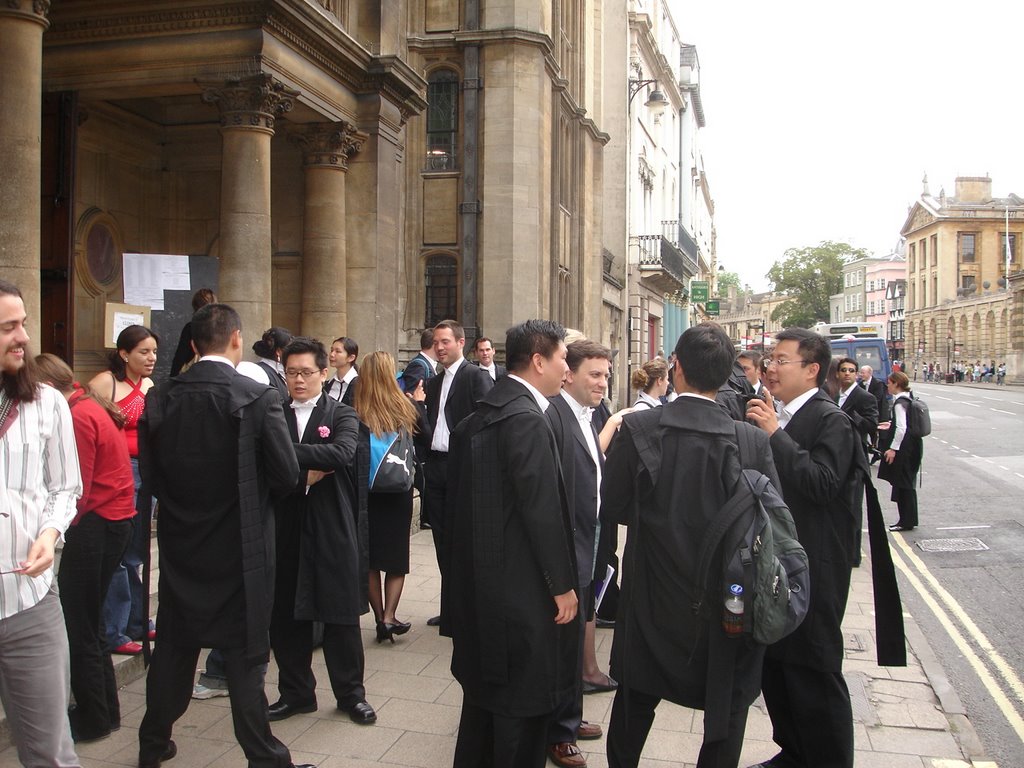
What a pleasure it is to see a student elegantly dressed. It makes a change from the dirty torn t-shirt and stonewashed ragged jeans. Oxford was, this month, in danger of losing the tradition that students be dressed in a dark suit, black shoes, a white bow tie, and plain white shirt and collar, with a cap and gown, known as subfusc. Subfusc is an ancient form of attire, worn by students at every formal university occasion including Examinations and Encaenia.

In Oxford it has been a common sight to see students dressed in subfusc, dashing to exams on a bicycle, looking vaguely like penguins from a distance. It has always given me a chuckle and a sense of pride about living in Oxford.

Unfortunately, this proud tradition was under threat from Oxford University Student’s Union (OUSU).Its President, Emma Norris launched a campaign to make the wearing of subfusc voluntary at university formal occasions by students. But the campaigners made a mistake, which successful revolutionaries never make - they consulted the electorate.

The student body held a referendum on this issue via the internet; the second time they had used such a system, but only those with student usernames could take part. Of the 4,000 who were polled, over 80% voted in favour of keeping the status quo!

Consequently, to her surprise, Emma Norris had to announce that, by the students’ vote, that subfusc would continue to be compulsory. So we will still see the joyful site of students celebrating the end of exams dressed in subfusc, popping balloons and champagne. Esto perpetua.

Tuesday, June 20, 2006

ARE HIGH WATER BILLS GREEN?

ARE HIGH WATER BILLS GREEN?
By Nicholas Newman
‘Southern England is suffering one of the driest summers on record, since 1933’, reports Ofwat the water regulator. So it has not been a good summer for the enthusiastic hose pipe user watering his plants or washing his car. Every week - news of another part of the country becomes subject to a drought order while complaints grow of water companies profiteering while failing their job to do their job properly of tackling these leaks.

Demands grow throughout the country that this profiteering must be stopped; utilities must bring to an end the practice of paying their Chief Executive (CEO) seemingly exorbitant salaries. The trouble is compared to other people working for major companies Thames Water (TW) CEO salary is moderate, only £800,000 per annum, little more than a premier league football player earns in four months. Yet the footballer does not have the problems of managing a £6bn investment project serving 13m customers. Then their accusations that with water bills increasing by 21% and profits up 6.1% last year that Thames is making excessive profits. But in terms of any similar sized business, its income levels and costs are reasonable if it is to be able to afford the massive £6bn in investment in its time expired supply network.

Demands that Thames should have moved ahead earlier ignores the time needed to launch such a large scale project. While criticisms about the scale of the scheme ignore that the country is experiencing a construction boom, the civil engineering sector is very tight at the moment, even with the import of expensive expertise from abroad.

If Thames critics were really serious in aiding Thames efforts to get the job done. Politicians like London Mayor Ken Livingstone would support Thames in its plans for a water desalination plant at Becton and locals living by the site of a proposed reservoir at Marsham would stop their protests which have managed to delay planning approval for a new reservoir new Marsham in Southern Oxfordshire. Both these projects if approved would go along way in preventing a repeat of hose pipe bans that are affect much of the Thames Valley. As for the Government, it is time the got their finger out and reformed the planning system, so as to cut the costly delays which under the present system mean it can take fifteen years for a scheme to come to fruition.

On our roads already the impact of road works is making life a nightmare at rush hour, if Thames did find the skilled men to carry out an increased rate of investment, we would be prepared to grin an bare it the added resultant delays – I sincerely doubt it. No if we are going to avoid the prospect of standpipes in the streets, I suggest you think like with energy how you can cut your water consumption and bills. If this means getting a water metre, stop using the dish washer, showering with a friend to save water. I suggest you follow Thames Water advice; it will not only save you money, but is green as well.

Friday, June 09, 2006

Energy

The long-running skirmishes between the EU and the French government have again been making the news, with Brussels arguably coming out on top in the latest tussles.
The EU's uncompromising competition supremo Neelie Kroes may well have been heartened by comments from French interior minister Nicolas Sarkozy, who has told Le Monde newspaper that there are serious doubts emerging about the viability of the contentious Suez-Gaz de France merger. Mr Sarkozy told the paper that vital deadlines for the merger-cum-privatization could be missed because both the president and prime minister 'are scared to move on a single issue'. The deal has been roundly criticized by other member states as a protectionist move orchestrated by Paris to create a French energy champion.
Then, to add insult to injury, the European Commission announced that it is to investigate issues of illegal subsidy and excessive payments in the country's savings market. Ms Kroes feels that the French state may have breached EU policy in its dealings with three mutual lenders that are allowed to offer the popular 'livret A' and 'livret bleu' savings accounts.
Taken together then, the EU could be seen as striking a welcome blow for open borders and free trade this week. However a more serious test of the state of Europe's free market ideals would come if Russian energy behemoth Gazprom mounts a bid for UK gas player Centrica - not such a remote possibility if remarks made by Gazprom's top brass at a conference this week are anything to go by.

Friday, May 05, 2006

Its time the Labour Party united behind Tony Blair

Prime Minister Tony Blair has reshuffled his cabinet after his Labour Party suffered heavy losses in local elections onThursday5 May. Foreign Secretary Jack Straw and Home Secretary CharlesClarke lost their high profile jobs, while John Prescott, Blair'sdeputy who was embroiled in a sex scandal, has been stripped of hisministry. Environment minister Margaret Beckett is to replace Strawand John Reid is to move into the important interior ministryposition. Provisional election results show that Labour lost morethan 260 local council seats, finishing on 26 percent overall. Outfront are the opposition Conservatives on 40 percent.

Sunday, April 23, 2006

Are the Left their own worse enemies?

Whatever the right and wrongs of the Iraq invasion (would a UN resolution really changed the opinions of the soppy anti Blairite left about the invasion?). Nevertheless – we are in the ‘here and now’ and we have to deal with the situation in Iraq as it is, and not as we wish it to be.

If you are still in favour of the insurgents/terrorists in Iraq as many of the soppy liberal left appear to be, they are acting against there own declared philosophy and the interests of the people of Iraq and appear to be arguing for an undemocratic theocratic dictatorship.

Why the Euston group offers a new direction for the left

Why the Euston group offers a new direction for the left A disparate set of left-wing thinkers meeting in a London pub has reopened an essential debate on the nature of democracy Will HuttonSunday April 23, 2006The Observer
To be on the left is to be both temperamentally inclined to dissent and to be passionate about your own utopia, which can never be achieved. Condemned to disappointment, you rage at the world, your party and your leader.
Relative peace comes when the right is in power and the left temporarily sinks its differences before the greater enemy. But to survive in office, the left leader must keep utopian factionalism at bay and that means making your followers understand hard realities and tough trade-offs and selling them the ones you make yourself.
Until Iraq, Blair had been pretty effective in squaring away his various critics, but the war has overwhelmed him. Almost every strand of left utopianism has been offended, from human-rights activists to anti-American imperialists, internationalists to straightforward peaceniks. And with Iraq now on the edge of civil war, their every fear and warning has been amply validated. With no strand in the left ready to utter a word in his support, the Prime Minister has had zero leverage to fight back. Down and down he has gone in the eyes of his left-wing critics.
Which is why a small meeting of disillusioned leftist journalists, university lecturers and passionate bloggers in a London pub last year is proving a potentially important political event. Two or three internet bloggers have been arguing strongly for some months that whether it was for or against the Iraq invasion, Western liberal opinion must now stand united behind the attempt to create and entrench the panoply of democratic and human rights in Iraq and be against the religious fundamentalism propelling it down.
Western liberalism has been making a fundamental mistake in claiming that, because they spring from a war so many of us opposed, the anti-Enlightenment jihadists and insurgents are somehow Bush and Blair's responsibility. The right course now is to construct an Iraqi democracy which means backing the hated Blair and Bush.
In short, a strand on the left passionate about democracy is coming to Blair's rescue. What started as a debate among those bloggers has now flourished into a fully fledged - and very long - manifesto, signed by more than 600 people, which covers everything from the Iraq war through anti-Americanism to globalisation and equality. For the full argument, read the Euston Manifesto on www.eustonmanifesto.org.

Friday, April 14, 2006

Has the media got it wrong over the NHS?

In the hunt for the NHS misspent millions the media blames the management or the politicians. Yet, these professional cynics are getting things wrong again in attributing blame. In fact even their solutions of giving power back to the nurses and doctors would make things worse for the NHS. It is simply ridiculous to suggest that the medical staff have the management skills needed to run an organisation which has an £87bn budget, has an economy equivalent to Austria, is the 33rst biggest economy in the world, and which employs over 1.3m people (as large as China’s armed forces).

Friday, March 31, 2006

To Russia with Condescention


News stories about Russia are treated by our media in a condescending and ill-informed manner.

Instead of the facts, we get the same old themes about the Kremlin acting dictatorially. We never get the detailed background behind the Kremlin’s actions. Take new Russian laws to regulate NGO’s. What is never reported is how the Russian mafia is using them to launder money or bribe politicians, yet, we in Europe, have similar regulations, to prevent such criminal activities.

The Russian - Ukrainian gas dispute, our media portrayed Russia as the big bad wolf threatening its former region. The truth seems to be that the old contract was providing cheaper fuel to Ukrainian industry than to Russian industry, and so Gazprom had to take action.

In a recent television programme, it was clear that the presenter/chairman did not comprehend the complex issues involved and pursued the media bias against the Russian government.

The British media must try to stop being condescending and try to present the underlying facts behind the story.

Wednesday, March 29, 2006

PR Inaction?

PR Inaction?

What a way to run an election. Low turnout and Israel condemned to having another weak coalition government. The voters’ verdict under PR means that only by a coalition of parties can a government be formed. Very small extremist parties will again be able to determine the agenda of mainstream politics.

As for the future, Hamas must be disappointed, dealing with a weak Israeli leadership, unable to take the tough decisions so essential for negotiations. In addition, Israeli business is disappointed that the coalition will not be strong enough to implement essential economic reform. Washington meanwhile, must be in despair, whilst still acting as paymaster.

PR has many good points, but in cases like Israel, it can clearly be disastrous.

Tuesday, March 28, 2006

OxfordBlog: Party Political Funding

OxfordBlog: Party Political Funding

Party Political Funding

Party Political Funding

The Westminster media village is all hot and bothered about the alleged payment for peerages. The solution is glaringly obvious – state party political funding!

This way, no political parties will have to depend on donations, dubious loans or alleged bribery for their election activities. Democracy costs money! From my campaign experience, it is obvious that voters are desperate for well-informed knowledge and plentiful information, on which to base their choice. They want to hear more, not less, arguments and debate. Dependence on old-fashioned leafleting (otherwise known as junk mail?) is ridiculous and the use of advertising, particularly the internet, is essential, so that the voter can make an informed and democratic choice. This involves, more, not less, money. Clearly, the present system is not up to it. Yes, state funding is inevitable.

French Strikes

On the bus to Oxford recently, I met Tom a staunch conservative of the old school. The conversation soon turned to the violent student demonstrations in Paris.

I was surprised when he argued that the French government should give in to the demonstrator’s demands. Tom thought it iniquitous of the French PM Devillepin to introduce new labour laws that that would discriminate against young workers. I pointed out that France was at a tipping point, if Devillepin surrendered on his Thatcherite reforms, France would soon turn into the sick man of Europe. I began to suspect that Tom was more concerned about the potential disruption to his planned Spring break at his Dordogne estate?

Thursday, March 16, 2006

European Common Energy Policy

European green paper in energy march 2006

BRUSSELS

March 8 should be celebrated as Europe’s energy independence day, when Commission President launched the EU’s Green Paper on providing the community with a Common Energy Policy. However, Europe’s energy dinosaurs greeted the prospect of the EU finally taking action to tackle the continent’s energy problems with fear and trepidation. Immediately calls for defence of national interests have been made to protect national energy companies from the threat of liberalisation of Europe’s energy markets was demanded. Energy lobbyists in both France and Spain struck up the banner of patriotism, the need to protect jobs and the local equivalent of the American dream. Little did they care for the damage such action would have on Europe’s business competitiveness, nor for the people that they were going to make unemployed or even the nightmare for pensioners living in fear of the next energy bill. Instead, their promotion of national champions will result as Commission President Barrosso says in the creation second division champions, when Europe needs Premier class champions to fight its corner in the world energy markets. To Read More http://www.oxfordprospect.co.uk/Europe%20Watch.htm

Monday, February 27, 2006

Making Poverty History?

Making Poverty History?
By Nicholas Newman
Hi! Don’t you agree that just forgiving third world debt is not the solution to tackling the poverty suffered by the poor in the third world, which the rich and famous like Dawn French and Bono would have us believe?
All it will do is reward the money grabbing elites that misrule those countries. Angola and Nigeria are major oil and gas producers, but they remain large debtors. In Angola, Global Witness reports that a quarter of oil revenue is unaccounted for each year, and one in four children dies in infancy. The poor in those countries remain poor despite the oil wealth. Debt, by itself, is not the principal cause of poverty in many economically failing states, but bad governance, incompetence and corruption. “Ordinary citizens in oil producing states of Angola, Equatorial Guinea or Kazakhstan have no information on what is happening to that money" Gavin Hayman of Global Witness told the BBC's Today programme. "The international community spends $200m each year trying to feed one million people in Angola who are critically dependent on international food aid," said Mr Hayman.
"Now given that $1.5bn is going missing from the treasury, there is a lot more they could be doing for their citizens."
All debt forgiveness or rescheduling does is to delay the day when such countries will need to make the painful process to reform their economic, governmental and political systems. The 1996 World Bank Report argues “Aid may have unintentionally encouraged misrule that led to collapse and civil conflict”. Almost all civil governance and public development in Africa is paid for by foreign aid, enabling African despots to wage wars on their neighbours.
Ethiopia is a good example of a failed state, a country fashionably popular with our rich and famous. In 2004 AFP reports, this much troubled land bought a new fleet of Sukhoi SU-27 fighter planes and military helicopters, costing millions of dollars, while two million citizens remain dependent on humanitarian food aid. Marti Ahtisaari, the UN special envoy for the Humanitarian Crisis in the Horn of Africa, blames current Ethiopian government policies in two key areas environmental and population polices as the cause of the country’s cycle of catastrophes.
Did you know debt forgiveness or rescheduling increases the cost of future borrowing - as such a process worsens the credit rating of such a state. Indonesia has rescheduled three times and the cost of borrowing has gone up each time. That explains why many third world states including Laos and Vietnam are against such proposals reports the World Bank
.Debt forgiveness or rescheduling is unfair on those countries that have made the effort to pay off their debts like India and Russia; in fact Russia will become a net creditor in a few years time, notes the OECD. Incidentally, there is a strong correlation between states that meet their repayments and later long term strong financial performance.
According to the OECD, did you know that almost every African country has witnessed a systematic regression of economic capacity over the last 30 years? The majority had better economic capacity at independence than they now possess. This poor economic performance is due to many reasons including absence of incentives for the private sector, government control of the economy, and discouraging investment laws., and, of course, corruption.
Having a simple regime change is not the solution; all you will do is replace one corrupt, incompetent, money grubbing elite with another. What is needed is a cultural change through economic, political and governmental reform, which will encourage the majority to work hard to transform their country into a modern prosperous state.
The oft sited mantra ‘that the only solution is to let such countries solve their problems themselves’ is now wearing thin according to often exasperated experts in the aid industry.
It looks like countries like Kenya need outside pressure to force significant change. When President Mwai Kibaki was elected three years ago, he promised Western aid donors and end to corruption by appointing the Kenya's National Anti-Corruption Campaign. Instead, his government has continued the two traditions of African governments, continued as before while paying lip service to Aid donors. This body was kept chronically under funded and blocked at every turn and its steering committee has resigned in disgust reports the Kenya’s Standard earlier this month. This together with the allegations of the Kenyan government ministers involved in a series of dodgy procurement deals worth millions of dollars reports the Kenya’s Sunday Standard.
Whilst Kenya’s Standard complains that ‘The government’s credibility in the fight against corruption has been in freefall in recent weeks, following a barbed attack by British High Commissioner Sir Edward Clay. Mr. Clay’s statement was followed shortly thereafter by the withdrawal of funding for the government’s anti-graft effort by the United States government and, on Friday, (18 February, 2005) by the German government’. It looks like the West is learning, letting Africa solve its own problems does not work - a more hands on, project by project, approach is certainly needed.
Prime Minister Tony Blair and President Bush are right to encourage democracy as part of the solution to turning round such basket cases. Simply throwing more aid to prop up corrupt incompetent regimes who neglect their countries duties to develop their countries for the benefit of the majority of its citizens is not the answer.
Since many of these poor states are victims of their corrupt governments, one possible solution would be for the EU adopt Robert Wheelan Institute of Economic Affairs (IEA) proposal. This proposes that the West should privatise the governance of such countries to EU approved multinationals to run such states under a profit sharing deal for a 21 year period, with the aim to rebuild, regenerate and develop these countries economies for the benefit of the majority of these countries citizens.
Somehow I don’t see Dawn French or her Vicar of Dibley persona starting a campaign to support Wheelan’s proposal?
Sunday, February 26, 2006

"THE EXTREMISTS WILL NEVER WIN" said Dr. Evan Harris Oxford West MP

Today (25 February), Oxford came out in support of the building of a new animal testing laboratory, Police estimate some 800 people marched through the streets of this historic university city, whilst members of the public broke out into spontaneous applause in support of the marchers as they past by, on this very cold February day. Amongst the speakers at this march were local MP Dr. Evan Harris and leading Oxford Neurosurgeon Professor Tipu Aziz.. For further information

Friday, February 24, 2006

OxfordBlog: Testing Out DAB Radios

OxfordBlog: Testing Out DAB Radios

Testing Out DAB Radios

Testing out the DAB radios what finally sold me an insatiable news junkie, was the pleasure of listening to digitally clear sound. The radio that most impressed me was the Roberts RD-14 Sports handheld digital radio. Not only is the price right at £100, it looks good and is user friendly, designed for ham fisted people like me. The graphics on the LCD display make it easy to read the scrolling text and it has an auto shut off function to save on battery life as well as an ac adapter when you don’t want to use the batteries. Like with previous radios I have purchased from Roberts the sound quality is crystal clear, good value and reliable. This will bring much pleasure to the daily grind of commuting. Though as a journalist that often works abroad, I am disappointed it cannot receive foreign digital radio stations; perhaps Roberts will include this in a later version. Buy Your DAB Radios Here

Is Cameron's honeymoon over?


Mr Cameron’s stardust is wearing off, according to two polls in today’s papers. A Mori poll in The Sun had 38 per cent of people saying that they would vote Labour if there was an election tomorrow, compared with 35 per cent for the Conservatives. This represents a 5 per cent drop for the Tories since last month. A YouGov poll for The Daily Telegraph put the Conservatives two points ahead of Labour, at 38 per cent to 36 per cent; 63 per cent of people agreed that the Tory leader “talks a good line but it is hard to know whether there is any substance behind the words”.

Why is immigration being used by France's elite , as an excuse for its failure to reform?

Ah, immigration has become the bugbear of politicians all over Europe. For us in France, both the left and the right are using it as a cause for all our social ills. It is perhaps not surprising that we founding nations of the European dream have opted out of letting the mass unemployed from the east fill the jobs we do not want to do. We in France have a state that has failed its citizens, we have estates full of unemployed, and we need Tony Blair to replace our present crop of failed leaders. Instead, our political elite blame their failures to modernise France on the immigrants.

Thursday, February 23, 2006

The Battle of Brussels


THE BATTLE OF BRUSSELS

What strikes me when I visit Brussels is the sheer diversity of views on any given topic under discussion. It just goes to show how our British eurosceptic media paints a rather one-sided picture of issues in Brussels. Recently, I was in discussion with journalists from all over Europe at a conference held in Brussels, discussing the big issues that affect us all. What amazed me was the sheer variety of opinions on such topics as immigration, farming and even enlargement.